

Northbrook Property Division Lawyer
Dividing property during a divorce carries lasting financial consequences. Decisions made during this phase can affect housing, retirement planning, income stability, and long-term security. When marital assets and debts must be addressed under Illinois law, clear legal guidance helps prevent costly mistakes.
A Northbrook property division lawyer assists individuals navigating asset division during divorce by explaining how Illinois courts evaluate property, clarifying what may be subject to division, and addressing disputes that arise when assets or debts are contested. Whether a divorce involves a family residence, retirement accounts, investment holdings, or business interests, the goal remains the same: achieving a fair outcome grounded in the facts of the marriage and the law.
Property division is rarely a purely financial exercise. Emotional attachments, future planning concerns, and uncertainty often shape negotiations. Legal structure brings focus back to statutory factors and evidence, helping divorcing spouses move forward with greater stability.


“Property division decisions shape financial life long after divorce is finalized. A careful review of assets, debts, and documentation helps reduce uncertainty and supports fair outcomes under Illinois law.”
To discuss how Illinois property division laws apply to your situation, call 312.593.0075 to speak with a Northbrook property division lawyer.
Table of Contents
How Property Division Works in an Illinois Divorce
Illinois follows an equitable distribution system for dividing marital property. Under this framework, courts divide assets and debts in a manner considered fair based on the circumstances of the marriage. Equitable does not automatically mean equal.
Judges evaluate several statutory factors, including:
- Length of the marriage
- Contributions made by each spouse
- Income and earning capacity
- Age, health, and future financial needs
- Prior agreements, such as prenuptial arrangements
A Northbrook property division lawyer focuses on organizing financial information and presenting it clearly, so the court can apply these factors accurately. Proper preparation reduces disputes and helps ensure decisions reflect the full financial picture rather than assumptions or incomplete records.

Marital vs. Non-Marital Property in Northbrook Divorces
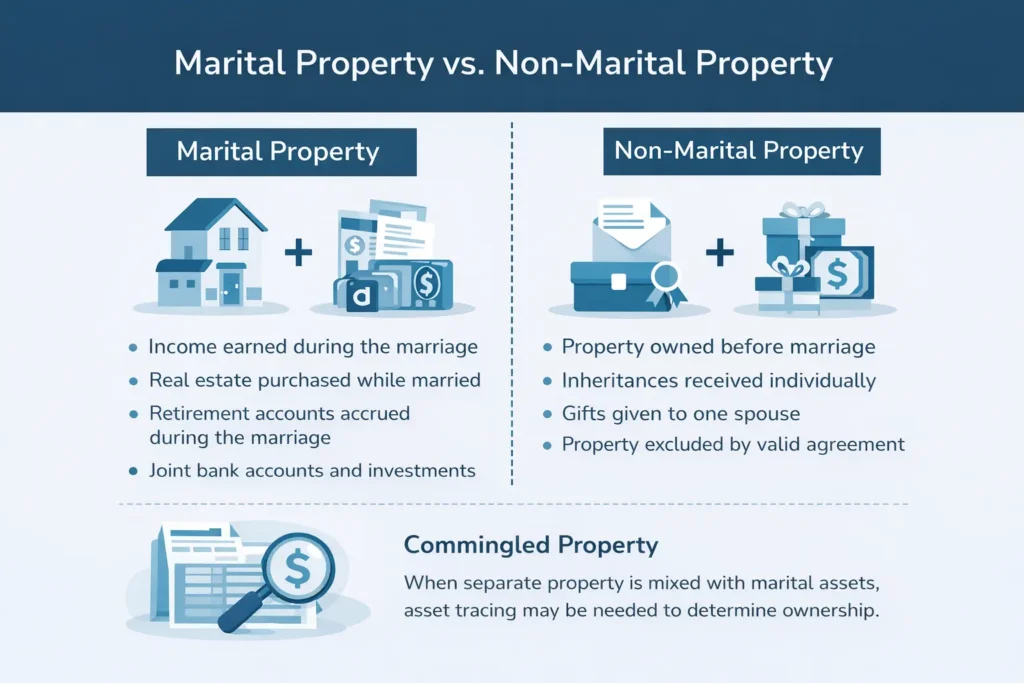
Classifying assets correctly is one of the most important steps in property division. Only marital property is subject to division under Illinois law.
What Qualifies as Marital Property
Marital property generally includes all the assets and debts acquired during the marriage, regardless of whose name appears on the account or title. Common examples include:
- Income earned while married
- Real estate purchased during the marriage
- Retirement benefits accrued during the marriage
- Joint bank accounts and investments
- Debts incurred for household or family purposes
Even assets held individually may be considered marital if they were acquired during the marriage or supported by marital income.
What Qualifies as Non-Marital Property
Non-marital property may remain with one spouse if it meets statutory requirements. This may include:
- Property owned before the marriage
- Inheritances received by one spouse
- Gifts given to one spouse individually
- Property excluded by valid agreement
However, classification disputes arise when non-marital assets are mixed with marital property.
Commingling and Asset Tracing
Commingling occurs when separate property is combined with marital assets, such as depositing inherited funds into a joint account. When this happens, asset tracing may be used to identify the original source of funds.
Tracing requires financial documentation, account records, and transaction histories. Without proper evidence, courts may treat commingled assets as marital property.
The Role of Financial Documentation in Property Division
Accurate financial documentation plays a central role in how property is evaluated and divided during an Illinois divorce. Courts rely on records, not assumptions, when determining which assets and debts are subject to division and how they should be allocated. Incomplete or disorganized documentation can delay resolution and increase the likelihood of disputes.
Common financial records reviewed during property division include tax returns, bank statements, retirement account summaries, credit card statements, mortgage documents, and business financials. These records help establish when assets were acquired, how funds were used, and whether property qualifies as marital or non-marital under Illinois law. Documentation is also used to evaluate debt responsibility and identify discrepancies that may affect equitable distribution.
Financial documentation becomes especially important when assets were acquired over time, accounts were shared and later separated, or property was partially funded with non-marital resources. In these situations, transaction histories and account records help clarify ownership and prevent misclassification.
Well-organized documentation supports productive negotiations and allows courts to apply statutory factors accurately. When financial information is presented clearly, property division decisions are more likely to reflect the actual financial circumstances of the marriage rather than estimates or incomplete disclosures.
Division of Marital Debt in Illinois Divorce
Property division in Illinois includes both assets and liabilities. Marital debt is evaluated and allocated using the same equitable distribution framework applied to assets. Courts look at when the debt was incurred, how it was used, and whether it benefited the household.
Common forms of marital debt include mortgages, credit card balances, auto loans, medical bills, and tax obligations accrued during the marriage. Even if a debt is held in one spouse’s name, it may still be treated as marital if it supported shared living expenses or family needs.
Non-marital debt, such as obligations incurred before the marriage or for personal purposes unrelated to the household, may remain with the individual spouse. Disputes often arise when credit lines were used for mixed purposes or when one spouse continued accumulating debt after separation.
Clear documentation helps courts evaluate debt responsibility accurately. Account statements, billing records, and transaction histories often play a role in determining how debt should be divided.
Handling High-Asset and Financially Detailed Property Division Cases
Divorces involving significant or varied assets require additional financial review. Errors in valuation or classification can affect long-term stability.
Real Estate and the Marital Residence
Real estate often represents a substantial portion of the marital estate. Options may include:
- Selling the property and dividing proceeds
- One spouse retaining the home through offset
- Deferred sale arrangements
Each option carries tax, financing, and housing considerations that require evaluation.

Retirement Accounts and Long-Term Assets
Retirement assets such as pensions, 401(k)s, and IRAs are frequently divided through court-approved orders. Proper handling helps reduce the risk of early withdrawal penalties and supports long-term value.
Business Interests and Professional Income
When a business or professional practice exists, valuation often requires review of:
- Revenue and expenses
- Ownership structure
- Market conditions
- Income history
Independent valuation tools help ensure fairness during division.
Financial Transparency and Undisclosed Assets
In some cases, disputes arise over missing income or undervalued assets. Financial records, tax filings, and discovery tools assist in clarifying discrepancies and supporting accurate division.
How Property Division Issues Intersect With Other Divorce Matters
Property division rarely exists in isolation. It often overlaps with:
- Child support considerations
- Spousal maintenance evaluations
- Divorce settlement negotiations
- Financial disclosure obligations
- Parenting arrangements involving housing stability
- Child support considerations
- Spousal maintenance evaluations
- Divorce settlement negotiations
- Financial disclosure obligations
- Parenting arrangements involving housing stability
Understanding how these areas interact helps reduce future disputes.
Why Legal Guidance Matters During Property Division
Property division agreements often shape financial stability long after a divorce is finalized. Without careful legal review, individuals may accept settlements that overlook long-term obligations, tax exposure, or future income considerations.
Legal guidance helps ensure marital and non-marital property is classified correctly, disputed valuations are addressed with documentation, and financial records are organized in a way that aligns with Illinois law. When disagreements arise, structured preparation allows financial issues to be resolved through negotiation or court review rather than assumption or pressure.
Attorney David Silberman has more than 15 years of experience handling family law matters involving contested financial issues. His approach emphasizes detailed financial review, strategic planning, and evidence-driven advocacy. This process-focused method supports informed decision-making and helps reduce financial uncertainty during and after divorce.
Speak With a Northbrook Property Division Lawyer
Property division decisions can affect financial stability long after a divorce is finalized. Getting clear legal guidance early can help prevent misclassification of assets, overlooked obligations, and avoidable disputes.
To discuss how Illinois property division laws apply to your situation, call 312.593.0075 to speak with a Northbrook property division lawyer at Silberman Law Group about your next steps.
Frequently Asked Questions About Property Division in Northbrook
Understanding how Illinois law approaches assets, debts, and finality can help individuals prepare for negotiations or court decisions. The following questions address common concerns that arise in Northbrook property division cases.
How does equitable distribution work in Illinois?
Equitable distribution means property is divided in a manner the court considers fair based on the circumstances of the marriage. Judges review statutory factors such as the length of the marriage, each spouse’s contributions, and future financial needs. This approach does not require an equal division, but it must be supported by the evidence presented.
Can property titled in one spouse’s name be divided?
Yes, property titled in one spouse’s name may still be subject to division if it was acquired during the marriage. Illinois courts focus on when and how the asset was obtained rather than whose name appears on the title. Documentation showing the source of funds often plays a key role in these determinations.
Are debts divided the same way as assets?
Marital debts are evaluated using the same equitable distribution framework applied to assets. Courts consider when the debt was incurred and whether it supported household or family expenses. Debts tied to non-marital purposes may be allocated differently depending on the facts.
Can property division orders be changed later?
Property division is generally final once a divorce judgment is entered. Courts rarely modify property awards unless limited legal grounds exist, such as fraud or clerical error. Because changes are difficult to obtain, careful review before finalization is important.
What happens if spouses cannot agree on property division?
If spouses cannot reach an agreement, the court will decide how marital property and debts are divided. This decision is based on statutory factors and the financial evidence submitted by both sides. Court involvement often increases the importance of accurate documentation and clear presentation.